by Brice Boorman
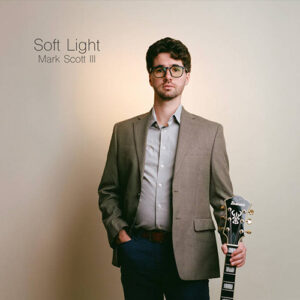
There is a quiet confidence to Soft Light, the debut album by Austin-based guitarist Mark Scott III. Scott plays with a confidence that does not announce itself through bravura or excess, but through control and patience. In an age where jazz guitar recordings often equate intensity with importance, Scott offers something different, an album that trusts the power of less is more.
Scott’s musical path has been shaped by strong roots in the Austin jazz scene and a deep engagement with jazz guitar tradition, and Soft Light reflects that grounding. This is an eleven-track exploration for guitar trio that draws from the mid-century jazz guitar lineage, particularly the sound world of Barney Kessel and slightly from Kenny Burrell. Scott brings his personal tone and temperament to this era and voicing.
The album opens with “Carpals,” an original inspired by Scott’s experience with wrist pain, and it immediately establishes the trio’s relaxed conversational ease. Scott’s improvisational language favors space, motivic development, and patient phrasing. Rhythmically, his feel subtly leans back on the eighth note, creating a gentle, relaxed swing that carries the lilt favored by mid-century guitarists like Kessel. It’s an approach that prioritizes storytelling over overt dramatic peaks.
That storytelling unfolds consistently across the album. Pieces like “Food Court” and “Rhythm-Ding” reveal Scott’s deep respect for tradition in his playing and composing. His tone is warm, rounded, and voiced with a clear jazz boxed treble hue. This allows the music to have a mellow overtone. Furthermore, Scott’s solos unfold with a narrative logic that feels conversational rather than declarative. Scott is not an extroverted narrator; he is a measured one, letting ideas develop organically and trusting the listener to follow.
The album’s emotional heart resides in its slower moments. The title track, “Soft Light,” is a tender, slow-swing ballad dedicated to loved ones who have passed. Here, Scott’s chord voicings and melodic pacing are supported by bassist Ben Triesch and drummer Mike Gordon. The trio’s communication allows the music’s emotional core to reveal itself. “Smile” also has a similar trio communication, but offered as a buoyant medium swing whose warmth lies in its ease rather than its exuberance.
“Tomorrow” stands out as the album’s most buoyant composition, its medium-up swing suggesting the promise of forward motion. Scott’s solo here is among his most engaging, buoyed by Triesch’s unwavering bass pulse and Gordon’s supple brushwork. One can easily imagine how Scott’s writing will flourish in expanded ensemble settings. Within the trio format, his sense of harmonic flow and melodic logic is compelling and complete.
The rhythm section plays a vital role throughout the album. Triesch’s bass lines are harmonically grounded and rhythmically assured, while Gordon’s stick and brushwork displays a finely tuned sense of texture and time. Their chemistry comes vividly into focus on “Monster Beat,” a groove-oriented track that steps briefly outside the album’s prevailing swing feel. The funk-inflected pulse introduces a shift in rhythmic placement, and Scott responds with relaxed assurance, blending blues vocabulary, jazz phrasing, and subtly exotic passing tones. It’s a display of the trio’s flexibility and collective intuition.
Taken as a complete listen, Soft Light unfolds with a cohesive, mellow arc. Tempos and tonal colors remain largely unified, but rather than feeling restrictive, this consistency creates a mellow, satisfying flow. The album moves at a steady, unhurried pace, a slow simmer that builds on the mid-century guitar spirit, especially when the mood calls for reflection rather than stimulation. Subtle contrasts in harmony, articulation, and rhythmic feel emerge naturally, enriching the experience without disrupting its charm. One looks forward to hearing where Mark Scott III’s journey leads next.

 By
By