by Brice Boorman
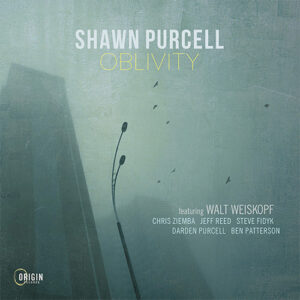
Guitarist and composer Shawn Purcell’s Oblivity presents an album statement built on shared melodic and harmonic understanding. The ensemble includes Walt Weiskopf on tenor saxophone, Darden Purcell on voice, Ben Patterson on trombone, Chris Ziemba on piano and Fender Rhodes, Jeff Reed on acoustic bass, and Steve Fidyk on drums and percussion. Each of the tracks devolved with various ensemble configurations. The continuity of the group functions as a working unit of players operating from the same specific post-bop modern jazz language.
Released on Origin Records and built entirely from Purcell’s original compositions, the album moves across straight-ahead swing, post-bop, Brazilian-influenced material, and groove-oriented electric textures. On paper, that reads like variety. In practice, it doesn’t behave that way. These shifts reveal how consistent the underlying approach really is between the players. The grounding is a modern jazz language, with long-form melodic phrasing, creative harmonic directions, and ensemble interactions that carry motifs through everything.
That becomes clear immediately on the title track. “Oblivity” moves forward on long, connected eighth-note lines. These phrases establish the subject and language of the harmonic movement. Fidyk shapes the flow with cymbal accents that respond to the line rather than impose on it, while Reed holds a steady quarter-note foundation underneath. When Purcell solos, everything flows in a manner that defines harmonic colors. Eighth-note figures move across multiple measures, connecting harmony with clear melodic intent. The same logic continues with all the soloists, moving in the same sense of time and expressive intent.
“Verdigris” shows this in its nearly ten-minute duration as the ground language of the ensemble never drifts. The center of gravity shifts from line to atmosphere as Ziemba’s voicings play a major role in the sense of continuity moving intact with Purcell and company. Each soloist approaches the space differently. Purcell builds through long, goal-oriented lines. Weiskopf expands vertically, using multi-octave motion to create an arc. Ziemba reshapes the harmonic color from inside the rhythm. Different strategies, same grounded modern jazz system.
Darden Purcell’s voice functions as part of that environment on four selections. In Verdigris,” her wordless lines carry a haunting, folk-like quality, shaped by a strong sense of pitch and legato phrasing. During the long eight-note tutti phrases, she blends with guitar and tenor; her voice adds a natural lyrical warmth. The three make a sound that softens the guitar’s attack while rounding the buzz of the saxophone. It changes how the line is heard in a very natural way.
“Primaries and Spares” shifts the surface toward a groove-driven setting rooted in soul jazz and early electric jazz language. The Rhodes establishes a deeper, more saturated tonal bed, and Purcell’s guitar tone meets it with a similarly warm, effected sound. The band locks into a consistent pocket, but the internal movement remains the same during solos. Long, driving lines that connect harmonically across phrases. Even within a fixed groove, the improvisation continues to express forward motion through line that move with rhythmic direction.
On “Meu Amor” the rhythmic texture opens, and the dynamic softens, but the modern jazz language holds. A Brazilian-influenced rhythmic feel, shaped by Fidyk’s percussion patterns and Reed’s naturally flowing bass lines, creates a relaxed, defined pulse. The melody carries the mood, moving through a post-bop harmonic progression with a consistent sense of direction. Voice and guitar blend within the written figures, their combined tone producing a warm, lyrical color. Though in a different setting, Purcell’s compositions align the ensemble within a melodic/harmonic framework, as each player connects each phrase to the harmonic movement with clarity.
Purcell and Weiskopf form a central axis throughout the album, their interaction grounded in a shared command of jazz language that allows ideas to move fluidly between them. Ziemba’s harmonic sensitivity, Reed’s steady and supportive foundation, and Fidyk’s ability to shift between swing, Afro-Latin, and groove-based feels without breaking momentum all reinforce the same collective understanding. Contributions from Darden Purcell and Ben Patterson expand the ensemble’s color without altering its core behavior.
Purcell’s Oblivity is a project with consistency in its musical language. Bebop, post-bop, Brazilian jazz, Afro-Cuban elements, and electric textures all appear, but they function as environments. The identity of the album comes from how the musicians move through harmony and how lines are shaped, connected, and resolved in real time to that harmony.
Every phrase points forward. Every line belongs to the same language. Every player operates inside that shared direction. Not fusion. Not contrast. Continuity.

 By
By