by Amity Hereweard
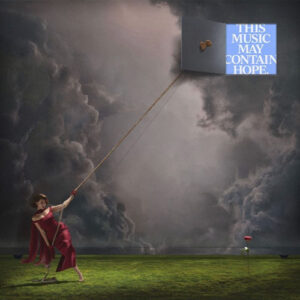
RAYE’s THIS MUSIC MAY CONTAIN HOPE operates as a creative and widely textured collection of songs, but as a unified artistic statement. Released in early 2026, the album presents a 73-minute journey with much attention to its construction. Following her departure from Polydor in 2021, RAYE has consistently pursued autonomy. That independence manifests continuity, even as the project’s styles shift dramatically. The work is divided into four distinct acts of Autumn, Winter, Spring, and Summer, which also connect the mapping of emotional trajectory from isolation to communal resolution.
The album begins with “Intro: Girl Under the Grey Cloud,” establishing the protagonist’s state through spoken word and a cello line that descends in a minor progression. The narrative voice describes a woman negotiating urban solitude, a theme that recurs throughout the project. Musically, the transition into “I Will Overcome” demonstrates RAYE’s command of vocal register. She moves from a low, chest-voice resonance to a high, airy falsetto, mirroring the lyrical tension between resignation and resolve.
The gospel choir enters the arrangement, introducing a call-and-response dynamic where the tenors and altos stack in soulful thirds. This signals a shift from individual struggle to collective support. The hip-hop elements introduced are integrated subtly; the drum pattern floats in the upper mid-range, leaving the low-end frequency space open for the soul foundation to remain intact.
The spring act highlights RAYE’s technical meticulousness. On “I Hate The Way I Look Today,” the arrangement pivots just before the minute mark, shifting the meter from a standard 4/4 swing to a 3/4 waltz. This gives RAYE’s phrasing the stage to elongate over the downbeat, producing a sense of suspension before snapping back into the 4/4 swing. Her scatting is rhythmic, locking tightly with the ride cymbals’ pattern. The bridge lyrics—“Words of affirmation must repeat till I believe it”—are delivered with a staccato articulation that grounds the theatricality.
This section continues with “Happier Times Ahead,” where the retro soul groove is anchored by a piano figure. The band enters after half a minute, with sharp horn stabs and a defined funk backbeat. The progression is linear; the music builds in density, with the brass section adding a fifth layer to the mix, supporting the lyrical assertion that “It can’t rain forever.”
The album’s collaborative credits reflect a thoughtful engagement with musical lineage. On “Click Clack Symphony,” Chris Hill and Tom Richards handle the orchestration, with the London Symphony Orchestra performing the parts. Hans Zimmer is a credited collaborator, contributing to the album’s rhythmic and textural landscape. The string section sustains chords, creating a shimmering, suspended tension. Later, orchestral hits drive the rhythm, acting as a percussive extension of the groove. At two and a half minutes, electronic textures and acoustic instruments are integrated. This creates a cohesive sonic environment, with RAYE’s narration atop a developing score that swells in dynamic range.
“Goodbye Henry” features Al Green, whose entrance at the three-minute mark is treated as a live performance within the studio context. The backing vocals stack in a gospel-and-soul mix, creating a warm harmonic bed of thirds and sixths. The two vocalists blend without competing; their timbres complement one another through key changes in the second half that modulate the emotional temperature. This interaction accentuates the album’s value of collaboration, as the guests are interlaced within the fabric of the arrangement.
On “Life Boat,” the production team of Jordan Riley and Punctual utilizes spoken-word samples from friends and family as rhythmic components. These snippets function as percussive transients; the syllables of “I’m not giving up yet” are gated to lock with the snare, creating a polyrhythmic layer over the bassline. The track oscillates between dance-floor energy and long-form narration, suggesting that the meta-elements are compositional tools rather than distractions.
While the lineage of British soul singers is unquestionable, THIS MUSIC MAY CONTAIN HOPE stands out through its stylistic ambition. The runtime of 73 minutes and 30 seconds allows for a development pace that defies current radio conventions, favoring long-form narrative arcs in place of immediate hooks.
At times, the album’s theatricality tests the listener’s patience. For example, the density of spoken-word samples in “Life Boat” and the stylized arrangement of “Fin” can disturb the melodic content. However, these choices support the album’s overarching narrative of hope. The conclusion features four and a half minutes of RAYE reading the credits over a cinematic score. This score shifts from a 1930s overtone to a power-pop crescendo. The gesture of credit reading values the contributors and grounds the project’s scale in human effort.
THIS MUSIC MAY CONTAIN HOPE is a work of significant continuity. It connects RAYE’s past explorations of soul and pop with a present-day focus on orchestral integration and narrative coherence. The production avoids vagueness; every arrangement choice serves the emotional arc. While the meta-commentary may not appeal to all listeners, the musical execution remains precise. For those attentive to the lineage of soul music and the craft of album construction, this record offers a clear, articulated vision of hope.

 By
By