
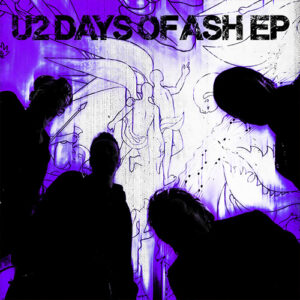
by Nolan Conghaile
When a band, like U2, that has spent half a century together finally decides to drop a six-track EP, expectations swing between reverent nostalgia and the fear that the legend has run out of steam. Listening to Days of Ash feels less like a triumphant return and more like a cautious, sometimes tentative, stroll through familiar terrain. Below is a track-by-track walkthrough, followed by a look at the EP’s recurring traits and the moments where the old guard still shines.
“American Obituary” bursts in with a new grain setting and watery jangle on the guitar from The Edge. There are moments where the guitar’s gain is pumped and cranked. Bono’s voice is eternally young, his timbre fresh and lively, yet the vocal delivery remains comfortably within his well-worn range. The track leans heavily on a classic U2 formula of layered guitars, a driving beat, and a soaring vocal.
“The Tears of Things”is a patchwork of acoustic and synth elements. The arrangement is hard-hitting with the synth backdrop giving the song a core that you will have to orbit several times before it reveals itself. Bono’s vocals are haunting and powerful. The dynamics are designed as a slow burn that has a gradual build that never fully resolves, leaving the piece to linger in a contemplative space rather than delivering a memorable hook.
Optimism surfaces briefly in “Songs of the Future.” The song is led by The Edge playing multiple guitar parts. The vocal delivery is mainly chill with moments of soaring. The overall tone is more optimistic than earlier material. Despite the upbeat veneer, the track’s structure remains straightforward, lacking any dramatic shifts.
A stark departure from the previous songs, “Wild Peace” is a spoken-word poem featuring producer Jacknife Lee and vocalist Adeola. Lowkey textures underpin the spoken verses, creating an ambient space for the words to live within. Because it is essentially a poem set to ambient music, there is little in the way of traditional instrumentation or vocal melody. The track functions more as an atmospheric pause that flows into the next fully realized song.
The EP regains some momentum in “One Life at a Time” with rolling drums and The Edge’s sparkling charm. All four members step-up for a slightly more energetic performance. The lyrical thrust is overtly hopeful. However, the track is careful not to become dreary or festive, attempting instead to strike a middle ground. The result is a modest, upbeat number that feels earnest but not particularly groundbreaking.
Closing the EP is “Yours Eternally.” The production stays firmly within U2’s storied sound, avoiding any heavy-metal pretensions. Bono’s delivery is strong as his full timbre delivers the catchy melody. The Edge provides multiple guitar textures, and the rhythm section of Larry Mullen Jr. (drums) and Adam Clayton (bass) builds a music setting that is convincing and fluid. Their consistency and subtle improvisations during the performance add depth and keep the performance unique.
U2’s six-track offering leans heavily on familiar signatures of the Edge’s layered guitars, Bono’s unmistakable timbre, and a solid rock rhythm section, while sprinkling in a few experimental detours (the spoken-word interlude, the orchestral patches). The result is an EP that feels more like a series of sketches than a cohesive statement.
The strongest moments are the opening rocker “American Obituary” and the hopeful closer “Yours Eternally.” In between, the songs hover in a comfortable middle ground: competent but rarely compelling. The recurring textures and motifs give the record a sense of unity, yet the lack of daring structural shifts or striking lyrical hooks leaves the listening experience feeling, at best, mildly satisfying and, at worst, a little undercooked.
For a band that has survived five decades, the willingness to experiment is commendable, but the execution here errs on the side of caution. Fans looking for a nostalgic reminder of U2’s classic sound will find familiar comforts; listeners hoping for a bold, forward-thinking reinvention may walk away feeling that Days of Ash, despite its title, is more of an obituary for risk than a celebration of the future.

 By
By