by Brice Boorman
There are composers who are stuck in history, and there are composers who reshape through it deliberately, as though time itself were a set of voices waiting to be rebalanced.
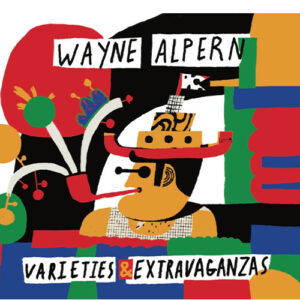
On Varieties & Extravaganzas, composer and arranger Wayne Alpern joins forces with the Times Square Brass Quintet, shaping a program of originals and reimagined works into a single, continuous language. This is a program of musical influences across time, where past and present are not contrasted, but layered, held in motion through lines that listen as much as they speak.
It is important to understand that this is not a collage of eras. It is a revoicing of memory through one of Alpern’s strongest gifts, counterpoint. His use of layered melodies is where history is organized in real time.
From the opening gestures of “Allegretto,” we are invited into a space where melody is never alone. A trumpet line rises, bright, ceremonial, but almost immediately, it is shadowed, answered, and refracted. The voices gather not as accompaniment, but as equals in a living dance of layers. What begins in the clarity of functional harmony slowly deepens, expanding into richer tonal color. The music naturally develops to show more than it first revealed. Each entrance is a thread pulled from a different century, but woven into a single, seamless fabric.
This is Alpern’s proposition: that history is not linear, but contrapuntal, a field of simultaneous voices, coexisting.
That idea finds a different kind of life in “Have You Met Miss Jones?”, where Broadway’s familiar contours dissolve into something more intricate, more playful. The swing pulse is there, unmistakable, but it doesn’t dominate. Instead, it circulates. Lines pass between instruments like whispered secrets, each voice inheriting and reshaping the phrase. At times, the arrangement itself becomes a clear statement by Alpern, the soloist. His writing blooms into a shout chorus that balances sounding orchestrated and spontaneous.
Alpern has described the piece as a “semi-classical arrangement” shaped by the architecture of West Coast jazz. He has captured that tradition where structures carry the weight of expression in a refined style with rhythmic fluidity. You can hear that lineage here, not as imitation, but as transformation: without a rhythm section, the quintet creates the time, turning swing into a network of interdependent lines that form the feeling.
What emerges across the album is a unified coherence, what Alpern has described as a “quest for transcendent unity through diversity,” realized not through juxtaposition alone, but through the deeper logic of counterpoint and understanding how that affects the listener’s experience.
Elsewhere, the album turns inward. “Motet” stands as a reflective pillar, where counterpoint becomes something almost devotional. The lines enter with intention, spaced carefully, each gesture leaving behind a resonance that lingers. There is a sense of compositional patience here, a form unfolding through the inevitability of the tensions and releases of the quintet.
Alpern has traced the origins of this piece back to his student years, writing in the style of Renaissance counterpoint, where “points of imitation” allow a single idea to pass from voice to voice in quiet succession. The beauty is he resisted strict adherence, noting that his aim was never imitation, but extension; “to use [these styles] as springboards for my own creativity.”
You can feel that impulse throughout the piece. Harmony, though grounded in early practice, stretches toward modern inflection, creating a subtle tension between the sacred and the contemporary. Silence plays its part too, framing each phrase like light through stained glass.
Throughout Varieties & Extravaganzas, counterpoint reveals itself as a compositional technique. However, it also evolves as a way of hearing. Each voice matters. Each line carries weight. No single line defines the whole. Instead, meaning emerges in the interactions between voices, which encourages the act of listening across difference.
This becomes especially vivid in “Parade,” where the brass quintet’s traditional character, rounded, ceremonial, almost Mozartean, takes on a lighter, more playful contour. What begins as a clear, grounded procession unfolds like a miniature scene where gestures are shaped with simplicity, but never reduced.
Beneath that surface, Alpern’s craft remains active. Rhythmic figures return and evolve in small, interlocking patterns, and instrumental pairings clarify motion within the contrapuntal texture. Even moments of subtle harmonic tension resolve with an ease that preserves the piece’s sense of balance. A softer, more subdued passage, like a distant call, introduces contrast without breaking the flow, allowing the music to breathe before continuing forward.
None of this complexity calls attention to itself. The writing carries a sense of unpretentious transparency, where structure supports rather than dominates. What emerges is a piece that holds its intelligence lightly, guided by charm, wit, and a faint echo of childhood imagination, where movement, memory, and sound converge in quiet motion.
That balance, between independence and unity, is the album’s quiet triumph.
Across the album, Alpern moves effortlessly between references as Baroque forms, early jazz idioms, Broadway melodies, and classical textures converge. The music never feels segmented. What becomes increasingly apparent is the consistency of Alpern’s ear and writing. Lines are always in motion, always aware of one another. Inner voices carry as much weight as melody, while the bass quietly anchors each transformation, giving shape to what might otherwise feel fleeting.
Patterns return in altered forms, rhythmic figures shifting, expanding, contracting, sometimes unfolding with the steady logic of a chorale, other times propelled by syncopation or swing. Even as harmonic language moves from grounded functionality toward more expansive color, it never abandons its sense of direction. Tension emerges, lingers, and resolves with a kind of inevitability, as though each moment were both anticipated and newly discovered.
Texture, too, is in constant dialogue with itself. Voices gather and disperse, pairing and separating to clarify motion within the contrapuntal field. At times, the music feels dense with interaction; at others, it opens into space, allowing a single gesture to resonate before the next begins. This interplay between density and clarity gives the album its sense of breath, its ability to move forward without urgency, to develop without excess.
The effect is cumulative. What begins as contrast gradually reveals itself as continuity; what first appears as stylistic distinction becomes structural unity. In Alpern’s writing, variation is the method through which coherence is formed.
And the Times Square Brass Quintet responds with remarkable sensitivity. Their playing is precise without rigidity, expressive without excess. Each instrument holds its own space while remaining attuned to the whole, creating a sense of equilibrium that allows the music’s complexity to feel natural, even inevitable. Tone, balance, and articulation are all shaped in service of the larger design.
Varieties & Extravaganzas does not ask us to choose between past and present. It asks us to hear them simultaneously. To recognize that musical history is not a sequence of endings, but a continuum of voices, still in conversation.
Alpern does not reconstruct history. He listens to it, then lets it speak again, differently.
And in that act of listening, something extraordinary happens: the past becomes present, and the present begins to echo forward, carried in the timeless breath of brass, where voices, once scattered across centuries, gather again to tell their stories through Varieties & Extravaganzas.

 By
By