
by Brice Boorman
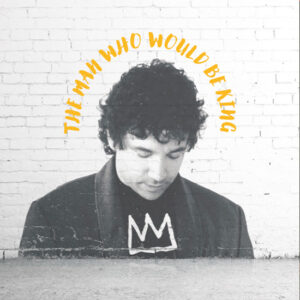
Adam De Lucia is a composer whose identity resides in a sound. That can be heard throughout De Lucia’s The Man Who Would Be King. Across eight compositions, electric guitars encounter strings, synthesizers, acoustic and electric keyboards, saxophones, flute, vocals, bass, drums, percussion, and electronic textures. Rock backbeats can sit beside jazz improvisation; chamber sonorities give way to fusion; modal passages coexist with funk-derived rhythms and harmonically restless melodies. What persists is a way of organizing musical sounds and their textures.
That is a revealing signature since De Lucia has described a composition-first process in which an internally heard idea can eventually reveal itself as rhythm, bass line, melody, harmony, or instrumental color. Genre does not have to be decided in advance. On The Man Who Would Be King, the consequences of that philosophy are audible in the arrangements: layers accumulate around stable anchors, themes return in altered forms, timbral changes announce formal movement, and unexpected melodic turns acquire logic from what surrounds them.
“Gorilla” offers a particularly clear example. The arrangement builds with subtle layers. A harmonic drone supplies enough stability for guitar and keyboard parts to enter in successive layers without requiring the underlying harmonic environment to be continually reinvented. The effect is architectural: the listener can hear the composition becoming denser while still understanding what the newer material is being added to.
Then the arrangement changes its priorities. The texture opens for the guitar solo, and an interlude shaped by keyboard color provides a transition into Donny McCaslin’s tenor saxophone feature. Later, saxophone and guitar come together in tutti material as the drums become increasingly prominent. Each event changes the foreground, but the composition retains a recognizable center.
Production is part of why the design remains legible. Warm instrumental tones and reverb establish a consistent sonic environment, while the instruments retain enough separation to occupy identifiable spaces across the soundstage. That clarity matters in music built through layers. Arrangement determines what enters and when; production allows the listener to perceive the relationships between those entrances.
“6 Day Regimen” achieves continuity through a shifting funk beat that supports a clean guitar melody whose rhythmic displacement keeps the theme from settling too comfortably. The middle section changes the character through percussion and a more impassioned saxophone passage, but the principal theme frames that contrasting material.
Its return is more important than simple repetition. The thematic idea is expanded through harmonic turns and changes in rhythmic proportion, including augmentation and diminution. The two major areas therefore complement one another rather than behaving like adjacent blocks. De Lucia does not leave the theme, insert a solo, and return to where he started. The composition makes the return itself part of the development. That tendency, to make contrast intelligible through arrangement, becomes one of the album’s recurring strengths.
It is especially apparent when the instrumentation changes substantially. “Will You Follow?” introduces synthesizers and keyboards as major melodic colors, with pitch-wheel movement lending expression to the electronic texture. A strong backbeat establishes the physical foundation, while syncopated handclaps help distinguish the B section before Chrissi Poland’s vocal entrance alters the center of attention again.
Here, timbre begins functioning almost like harmony or rhythm as a formal device. Samples, synthesizers, keyboards, voice, and percussion don’t simply decorate sections that would otherwise be interchangeable. Their entrances help define those sections. A new combination of colors tells the ear that the composition has gone somewhere.
That makes “Will You Follow?” important to the larger album. The Man Who Would Be King is not coherent because every track maintains the same instrumental hierarchy. De Lucia can move from instrumental fusion into a more vocal and electronically orchestrated environment without abandoning the organizational habits that characterize the surrounding music.
“Girl” pushes into a rock-oriented beat that carries a distinct ‘70s-fusion cast, while male and female voices add another layer of color against harmonically rich backgrounds. The melody is particularly revealing because it keeps taking turns that resist the most obvious destination. The arrangement continually supplies enough context to make them understandable.
That relationship may say more about De Lucia’s compositional personality than any genre description could. His melodies do not always need to behave predictably because the arrangement can provide the logic around them. Harmony, rhythm, texture, and instrumental placement become part of the explanation.
The same organizational thinking can be heard from other perspectives elsewhere on the album. On “Cycle One,” chamber-oriented strings help frame a composition that moves into an electric fusion environment before the string sonority returns. “Store On the Corner” negotiates backbeat, modal change, a more open interlude, and tightly arranged saxophone-and-guitar material without becoming episodic. “8 Out” derives formal momentum from recurring rhythmic patterns and displacement. “Carousel” accommodates modal color, changing rhythmic environments, guitar and saxophone writing, and tutti figures within one continuously evolving structure.
Taken together, those pieces suggest that stylistic consistency may be the wrong standard by which to understand The Man Who Would Be King. The album’s consistency is procedural.
That becomes especially significant given its long development. The project grew across years of recording, revision, re-recording, remote collaboration, and studio work rather than emerging from a single ensemble configuration captured during one concentrated session. Some compositions have histories extending well before the completed 2026 album. Such a process could result in a collection whose individual pieces retain the fingerprints of different periods more strongly than they share an album identity. De Lucia solves that problem through organization.
The record does not require the same personnel, instrumentation, groove, or production gesture on every track. Instead, related compositional behaviors keep resurfacing: an anchor permits complexity around it; a theme establishes itself strongly enough to withstand transformation; a change of texture articulates a section; recurring material returns altered by what has happened since its previous appearance.
Even the production participates in that process. Acoustic, electric, vocal, and electronic materials are not forced into artificial uniformity. Their differences remain audible, but the mixes generally provide enough definition for complex arrangements to be understood as relationships among parts rather than masses of accumulated sound.
That is an important distinction for an album this stylistically broad. “Eclectic” would describe what De Lucia has assembled, but it would tell us little about why the assembly works. “Genre-bending” would be similarly incomplete. The interesting part is not that progressive rock, jazz improvisation, funk, chamber textures, vocals, electronics, and fusion can all be identified somewhere in the record. It is what De Lucia does after putting them there.
Again and again, the arrangement makes sense of the unexpected. A new layer has an anchor. A contrasting section has a relationship to what surrounds it. A returning theme carries evidence of development. A change in instrumental color has formal consequences.
That is where The Man Who Would Be King establishes its identity. De Lucia’s compositional fingerprint operates one level deeper than surface style. The sounds keep changing, but the organizing mind behind them does not.


 By
By