
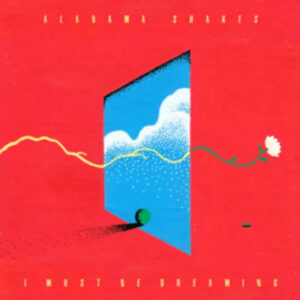
by Nolan Conghaile
Eleven years separate Alabama Shakes’ Sound & Color from I Must Be Dreaming, but the more revealing measure of distance is inside the songs. The band’s third album does not simply broaden its mixture of rock, soul, blues, and R&B. Alabama Shakes now seems particularly interested in what can happen to a musical idea after it has been established. Riffs return in different surroundings. Grooves remain steady while textures multiply. Vocal lines acquire countervoices, and repeated sections gather instrumental details that alter their weight and direction.
That makes arrangement part of the songwriting on I Must Be Dreaming. Produced by Alabama Shakes with Shawn Everett, the album finds Brittany Howard, guitarist Heath Fogg, and bassist Zac Cockrell returning not by attempting to reproduce their earlier sound, but by extending the exploratory tendencies already apparent on Sound & Color. The expanded palette matters, but what matters more is how deliberately the band puts it to work.
“Another Life” demonstrates how naturally that development happens within the band. A catchy eight-note pattern shared by synthesizer and guitar establishes a firm center. Alabama Shakes gradually complicates that initial clarity. Additional guitar and keyboard parts appear on subsequent passes, and backing vocals begin answering Howard in call-and-response figures. What initially feels like a compact recurring pattern becomes the foundation for an increasingly active arrangement.
Howard develops with it. Her soulful delivery moves through sustained legato phrases and glissandos into the upper register, while the bridge changes the harmonic setting and opens space for falsetto. An ascending guitar figure increases the momentum before becoming a melodic voice of its own, repeating tones and eventually moving in counterpoint with the lead and backing vocals. Lower and middle vocal harmonies further enlarge the texture. Yet rather than forcing a grand final resolution, the song fades toward the atmosphere from which it began. Repetition has provided the frame; everything Alabama Shakes places around it has changed the view.
“Garden” puts a different rhythmic environment in our world. Its slow 6/8 shuffle establishes a moody sway, with Cockrell’s bass and the drums reinforcing the backbeat while Fogg’s guitar works more texturally. Keyboards contribute several shades of color without obscuring the groove. Band hits punctuate the flow, gaining force precisely because the ensemble leaves enough room around them.
On the next movement through the form, instruments that have already established their functions begin introducing new details. Howard’s wide range and soul-inflected glissandos remain central, but increasingly rich background harmonies turn the vocal arrangement into an ensemble event. Dreamy keyboards, a brief minor coloring, wordless vocals, restrained horn sonorities, and eventually vocal counterpoint develop around the underlying shuffle. The groove does not disappear beneath the complexity. It is what makes the complexity possible.
That relationship between foundation and expansion becomes still more dramatic on “I Feel Hope Coming.” Slowly strummed guitar chords and swelling keyboards initially suspend the music before a tempo change brings Howard’s wordless vocal, bass, drums, and rhythmic guitar into a medium-tempo sway. A band hit suddenly removes that support and leaves Howard exposed as she rises into falsetto. When the ensemble returns, it does so with greater energy.
From there, the song keeps finding another level. Howard’s falsetto gains power; guitars and keyboards expand their parts; toms introduce a new tutti figure; ensemble hits become increasingly prominent; and backing voices eventually join the returning upper-register vocal. By the time repeated vocal phrases and developing keyboard textures carry the music toward its ending, the relatively spacious opening has become something communal.
That trajectory continues forward in “I Feel Hope Coming.” Engaging explicitly with contemporary social and political anxieties. Alabama Shakes does not rely solely on the lyric to communicate the title’s promise. Hope becomes an arranging process. What begins with space and an exposed individual voice acquires rhythm, instrumental layers, supporting voices, and collective force.
“American Dream” is moody with darker possibility within the same method. A syncopated guitar-and-bass figure supplies its recurring foundation, but Howard’s vocal arrives with a noticeably altered production color, slightly distorted and processed without sacrificing the warmth of her delivery. Sustained backing voices answer her, while held guitar chords and keyboards thicken subsequent repetitions.
As Howard rises in register, the band moves into a tutti interlude surrounded by sounds swimming in delay. The repeated vocal idea then encounters a darker harmonic turn. Particularly effective is the tension created by a sustained pedal tone against the recurring riff. Rather than allowing repetition to reassure, Alabama Shakes makes the familiar figure feel increasingly unsettled. The eventual return of the tutti riff provides the cadence, but it does not erase the unease built along the way.
The contrast between “I Feel Hope Coming” and “American Dream” reveals how flexible the band’s arranging language has become. One builds outward until an initially exposed voice feels surrounded by collective possibility; the other places color and harmonic tension around a recurring figure until stability begins to feel uncertain. The underlying technique is similar, but the emotional destination changes.
Howard remains an unmistakable presence throughout I Must Be Dreaming. Her range, timbre, falsetto, glissandos, and ability to move from intimate phrasing to tremendous vocal force would be enough to dominate a less responsive ensemble. What makes these performances compelling, however, is how often the musicians develop alongside her. A rising vocal register can prompt greater instrumental density. A backing-vocal response can become counterpoint. Guitar can move from texture to melody. Bass and drums can preserve the identity of a groove while keyboards, voices, and effects transform everything surrounding it.
That is why the album’s expanded sonic palette hits with the band’s command of it. Atmosphere, overdubs, effects, vocal layers, and contrasting timbres are abundant, but abundance alone is not the achievement. The important question is whether each addition changes how the listener experiences the underlying musical idea.
Again and again, it does.
After more than a decade away, Alabama Shakes could easily have made reunion itself the event. Instead, I Must Be Dreaming finds its identity in musical development. The riffs and grooves are memorable, Howard’s singing remains formidable, and the band’s roots remain audible, but none of those elements is treated as static. Alabama Shakes establishes an idea, reshapes its surroundings, and listens for what it can become. On I Must Be Dreaming, repetition is not where the songwriting stops. It is where the possibilities begin.


 By
By